Rack Server vs Tower Server vs Blade Server: Complete Comparison Guide (2026)
Discover the key differences between rack, tower, and blade servers. Learn which server type best suits your business based on performance, scalability, budget, and future growth.
Rack Server vs Tower Server vs Blade Server: Complete Comparison Guide (2026)
Choosing the right server is one of the most important decisions for any business planning to build or upgrade its IT infrastructure. Whether you're managing a small office, a growing enterprise, or a large-scale data centre, the server you select will influence your performance, storage capabilities, expansion potential, and overall operational efficiency. Among the most common enterprise server options available today are rack servers, tower servers, and blade servers. Although they all perform the same fundamental role of processing and storing business data, each is designed for different workloads and environments.
Understanding the strengths and limitations of these server types will help you make an informed investment that supports both your current operations and future business growth.
What Is a Rack Server?
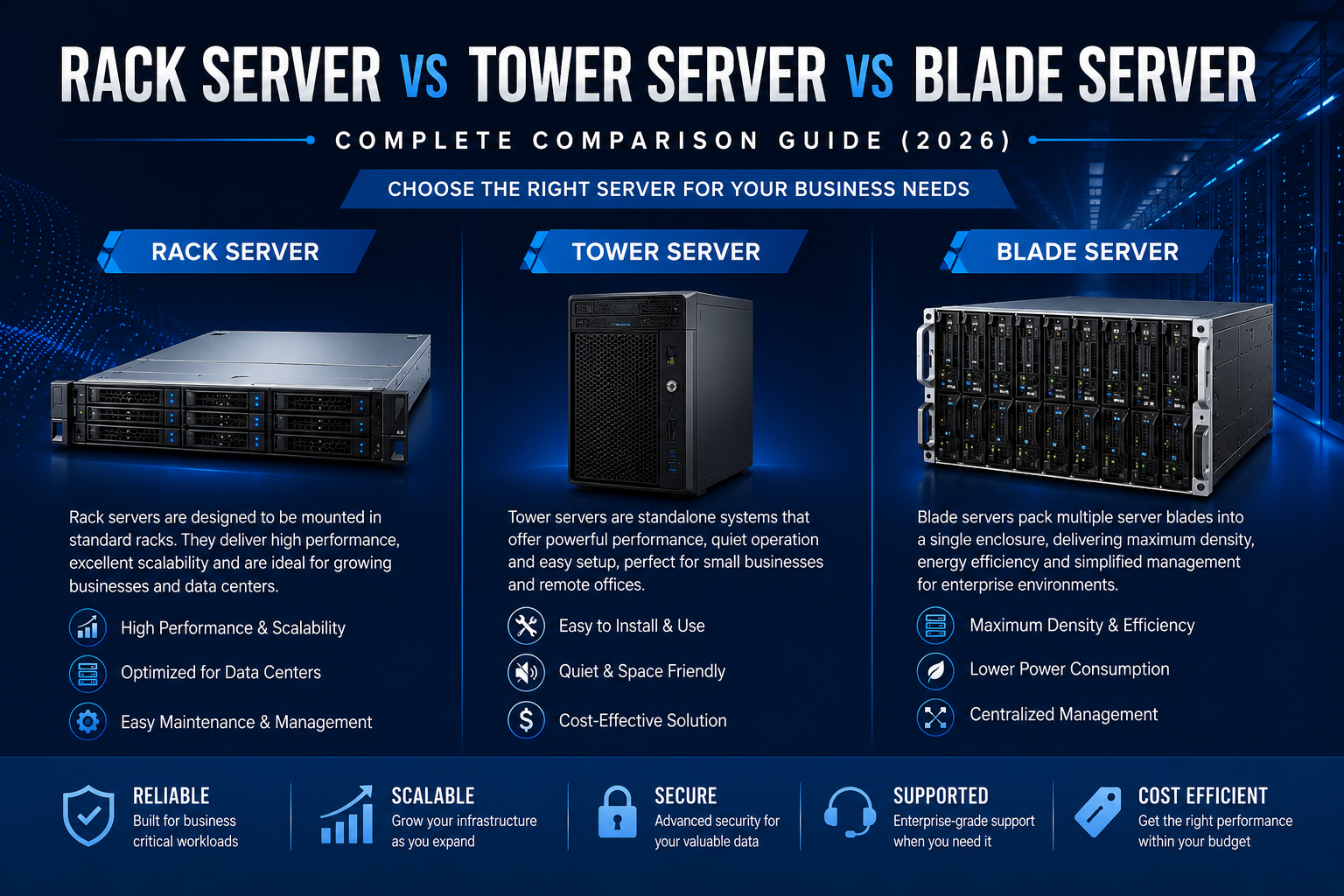
A Rack Server is a compact, high-performance server designed to be mounted inside a standard server rack. Multiple rack servers can be installed vertically within the same cabinet, making them an excellent choice for businesses that require a large number of servers while conserving floor space.
Rack servers are widely used in enterprise environments because they provide excellent scalability and simplify cable management, maintenance, and system upgrades. They are commonly deployed for virtualization, cloud computing, database hosting, web applications, and enterprise resource planning (ERP) systems.
If your business expects continuous growth or requires multiple servers operating together, a rack server offers the flexibility needed to expand without replacing your existing infrastructure.
What Is a Tower Server?
A tower server resembles a traditional desktop computer but is built with enterprise-grade hardware designed for continuous operation. Unlike rack servers, tower servers do not require a dedicated server cabinet, making them easier to install and maintain for organisations with limited IT infrastructure.
Tower servers are particularly popular among small and medium-sized businesses because they offer a cost-effective solution without compromising reliability. They generate less noise than rack-mounted systems and are suitable for businesses running file sharing, office applications, backup systems, accounting software, or local business databases.
For organisations that only require one or two servers, tower servers often provide the best balance between performance and affordability.
What Is a Blade Server?
Blade servers are designed for organisations that need maximum computing power in the smallest possible footprint. Instead of operating as individual units, multiple blade servers are installed inside a shared enclosure that provides common power supplies, cooling systems, networking, and management resources.
This design significantly reduces cable clutter, improves energy efficiency, and simplifies server administration. Blade servers are commonly found in enterprise data centres, cloud service providers, research institutions, and organisations running artificial intelligence, machine learning, and high-performance computing applications.
Although blade servers require a higher initial investment, they deliver outstanding scalability and operational efficiency for businesses with demanding workloads.
Key Differences Between Rack, Tower, and Blade Servers
The biggest difference lies in how each server is deployed and managed. Tower servers are standalone systems designed for simplicity and lower upfront costs, making them ideal for businesses with modest computing requirements.
Rack servers are built for organisations that need greater scalability and efficient use of physical space. Their modular design allows businesses to add more servers as demand increases without major infrastructure changes.
Blade servers take scalability even further by sharing power, cooling, and networking resources across multiple server modules. This approach reduces operating costs while delivering exceptional performance, but it is generally best suited for large enterprises and mission-critical environments.
Which Server Is Right for Your Business?
The right server depends entirely on your business goals, workload, available space, and future expansion plans.
If you operate a small business or branch office and require reliable performance with minimal setup, a tower server is often the most practical solution.
Businesses planning to expand their IT infrastructure, implement virtualization, or host multiple business applications should consider rack servers because they provide greater flexibility and long-term scalability.
For organisations managing complex enterprise applications, cloud infrastructure, or AI-driven workloads, blade servers deliver unmatched computing density and centralised management, making them an excellent long-term investment.
Final Thoughts
There is no single server type that is perfect for every organisation. Tower servers remain an excellent option for businesses seeking simplicity and affordability. Rack servers provide the ideal balance between performance, scalability, and efficient space utilisation, making them the preferred choice for many modern enterprises. Blade servers, meanwhile, offer exceptional computing density and centralised management for organisations operating large-scale, mission-critical environments.
Before making a purchasing decision, evaluate your current workload, anticipated business growth, available infrastructure, and budget. Choosing the right server today will help ensure better performance, improved reliability, and lower operational costs in the years ahead. Whether you're upgrading existing hardware or deploying a new IT environment, selecting the appropriate server architecture is an investment in your organisation's future success.