HPE ProLiant Gen12 vs Gen11 Server: Is the Upgrade Worth It?
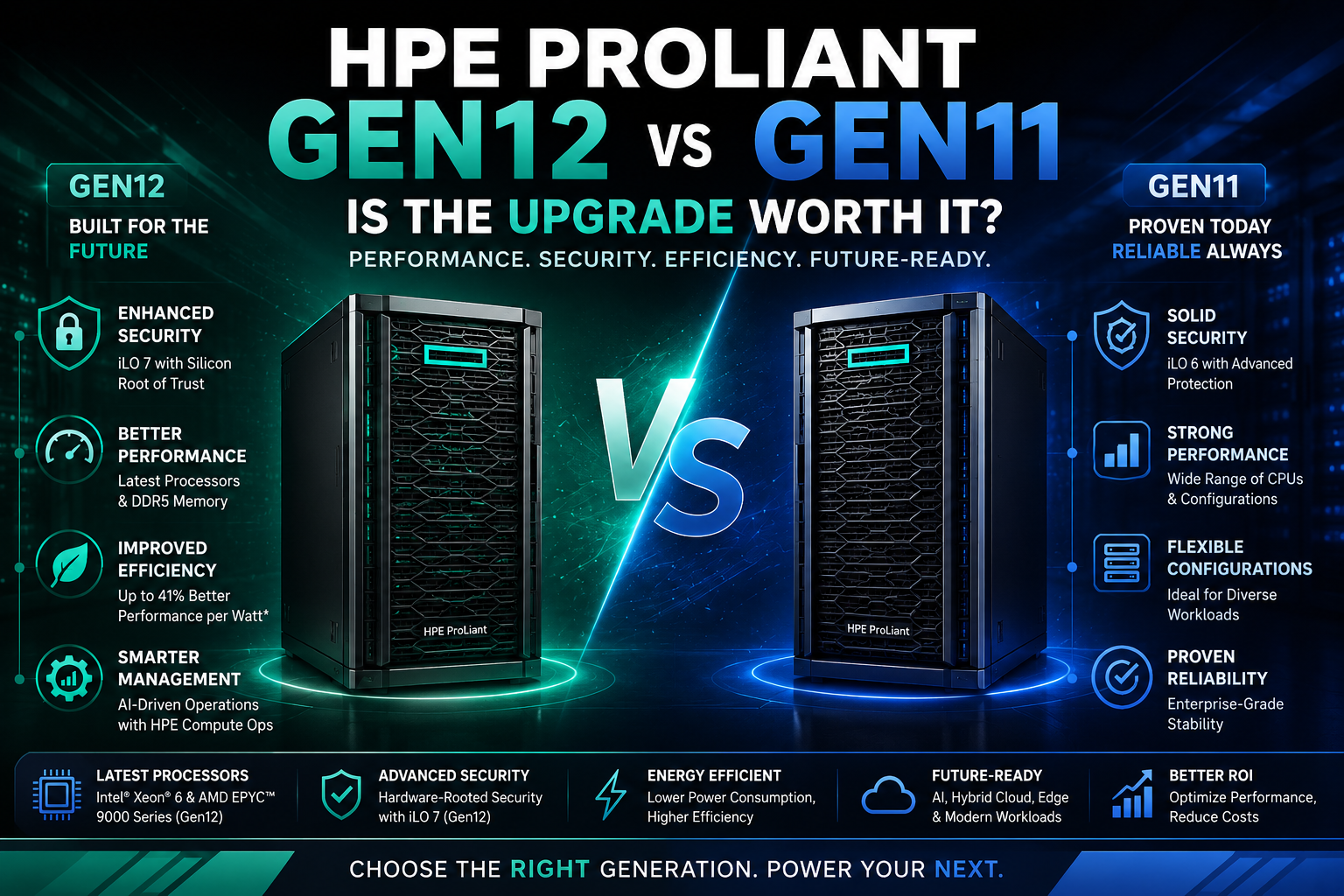
HPE ProLiant Gen12 introduces newer processors, enhanced security, improved efficiency, and advanced management capabilities. Find out whether upgrading from Gen11 makes sense for your business.
Enterprise server technology continues to evolve as businesses demand more computing power, stronger security, better energy efficiency, and easier infrastructure management. For organizations currently running HPE ProLiant Gen11 Servers, one question naturally comes up: is it worth upgrading to HPE ProLiant Gen12 Server?
The answer isn't the same for every business.
HPE ProLiant Gen11 remains a capable enterprise server platform supporting demanding workloads including virtualization, databases, cloud applications, AI, analytics, and VDI. HPE introduced Gen11 with support for 4th-generation AMD EPYC, 4th-generation Intel Xeon Scalable, and other processor platforms, along with DDR5 memory and PCIe Gen5 capabilities.
Gen12 builds on that foundation with newer processor options, stronger hardware-rooted security, improved energy efficiency, AI-assisted management, and workload-focused platform designs. HPE announced its first major Gen12 portfolio in 2025, positioning the generation for AI, analytics, edge computing, hybrid cloud, and VDI workloads.
So, should you upgrade?
Let's look at what actually changes.
What Is New With HPE ProLiant Gen12?
Gen12 isn't simply a faster version of Gen11. HPE has focused the new generation on several areas that have become increasingly important for modern data centers.
The biggest improvements are found in security, processor technology, power efficiency, management, and support for demanding workloads.
HPE's Gen12 portfolio includes systems based on newer Intel Xeon 6 processors as well as newer AMD EPYC-powered models. HPE has also expanded the portfolio for workloads ranging from virtualization and VDI to AI and edge computing.
This makes Gen12 particularly interesting for organizations refreshing infrastructure that is expected to remain in service for several years.
Performance: Gen12 vs Gen11
Performance is one of the first reasons businesses consider a server upgrade.
Gen11 already provides substantial processing capability. Depending on the model, Gen11 systems support processors from AMD and Intel with high core counts, DDR5 memory, PCIe Gen5 I/O, and extensive storage and accelerator options.
Gen12 moves to newer processor architectures and is designed to provide additional performance and efficiency for modern workloads.
HPE says its Gen12 systems can deliver up to 41% better performance per watt compared with legacy enterprise systems, while certain Gen12 configurations can provide substantial annual power savings. These figures are HPE's published claims and depend on the systems and workloads being compared.
For businesses running CPU-intensive applications, virtualization, analytics, or AI workloads, the performance-per-watt improvement may be more important than raw processing speed.
Should you upgrade for performance?
Upgrade if: your existing Gen11 servers regularly reach CPU, memory, or I/O limits.
Stay with Gen11 if: your current systems comfortably handle workloads and there is no immediate performance bottleneck.
Security Is One of Gen12's Biggest Advantages
Security is arguably one of the most important differences between the generations.
Gen11 introduced strong security capabilities and HPE iLO 6. Gen12 takes the platform further with HPE iLO 7 on supported Gen12 systems.
HPE describes iLO 7 as a hardware-rooted security foundation designed to protect the server throughout its lifecycle. Gen12 systems with iLO 7 include a secure enclave for protecting sensitive server encryption keys and additional firmware verification capabilities.
HPE also states that its Gen12 platform is designed to address future security requirements, including support for NIST and CNSA 2.0 quantum-resistance requirements on applicable platforms.
This matters particularly to organizations handling:
- Financial information
- Healthcare data
- Government workloads
- Customer databases
- Intellectual property
- AI and sensitive business data
If infrastructure security is a major concern, Gen12 offers a compelling reason to consider an upgrade.
HPE iLO 7 vs iLO 6
Remote server management is another area where the generations differ.
Many Gen11 ProLiant servers use HPE iLO 6, while Gen12 systems with the newer architecture use HPE iLO 7. HPE's own documentation lists iLO 7 for Gen12 and iLO 6 for Gen11 platforms, although specific Gen12 models can vary.
iLO provides capabilities such as:
- Remote server monitoring
- Hardware health monitoring
- Firmware management
- Power management
- Thermal control
- Remote administration
For IT teams managing servers across multiple locations, improvements in remote management and security can reduce administrative effort.
Energy Efficiency and Data Center Costs
Power consumption has become a major consideration when operating enterprise servers.
A server doesn't only cost money when it is purchased. It also consumes electricity and generates heat that must be removed through cooling infrastructure.
HPE designed Gen12 with a stronger emphasis on performance efficiency. HPE reports up to 41% better performance per watt compared with legacy enterprise systems and highlights significant potential annual power savings for certain configurations.
This can become particularly important when operating dozens or hundreds of servers.
For example, if your data center is approaching power or cooling limits, moving to more efficient hardware can potentially increase compute capacity without expanding the facility at the same rate.
Gen12 for AI and Modern Workloads
AI is another major reason businesses are evaluating newer server platforms.
Gen11 supports AI and GPU-accelerated workloads, and HPE specifically positioned Gen11 for AI, machine learning, analytics, and graphics-intensive applications.
However, Gen12 expands HPE's focus on AI infrastructure and newer accelerator-enabled platforms.
HPE describes Gen12 as being designed for demanding workloads including AI, data analytics, edge computing, hybrid cloud, and VDI.
If you're planning to introduce AI workloads over the next few years, Gen12 may provide a more suitable foundation for a new deployment.
Virtualization: Do You Really Need Gen12?
Virtualization is one area where the answer isn't always straightforward.
If your Gen11 infrastructure is running VMware, Hyper-V, or another virtualization platform comfortably, replacing it solely because Gen12 exists may not provide enough financial benefit.
However, consider Gen12 if your existing environment is experiencing:
- Increasing VM density
- Memory shortages
- CPU bottlenecks
- Storage performance limitations
- Increasing power consumption
- Capacity constraints
HPE has also expanded Gen12 support for virtualization-focused workloads, including newer AMD EPYC-powered systems designed for memory-intensive virtualization and VDI environments. HPE announced that the DL325 and DL345 Gen12 can support up to 6 TB of memory in certain configurations.
Is Gen11 Still Worth Buying?
Absolutely—depending on the situation.
Gen11 shouldn't automatically be considered obsolete simply because Gen12 is available.
A well-configured Gen11 server can still be an excellent choice for:
- File servers
- Backup infrastructure
- Virtualization
- Databases
- Business applications
- Development environments
- Secondary data centers
- Disaster recovery
- Budget-conscious deployments
For organizations that don't require the latest security architecture or processor platform, a properly configured Gen11 server can provide excellent value.
This is particularly relevant when purchasing certified refurbished HPE servers, where Gen11 hardware can offer enterprise capabilities at a lower acquisition cost.
When Should You Upgrade From Gen11 to Gen12?
An upgrade makes the most sense when your current infrastructure has reached a practical limitation.
Consider moving to Gen12 when:
Your workload has grown
If applications require significantly more CPU, memory, storage, or I/O capacity, a newer platform can provide the headroom required for future growth.
Security requirements have changed
Organizations with stricter security requirements may benefit from the additional hardware-rooted capabilities available on supported Gen12 systems.
Power and cooling are becoming expensive
Improved performance per watt can make a generational upgrade attractive in large server deployments.
You're planning an infrastructure refresh
If your Gen11 servers are already approaching their planned replacement cycle, Gen12 can provide a longer runway for the next infrastructure investment.
You're introducing AI workloads
Businesses moving toward GPU-accelerated AI, analytics, or inference workloads should evaluate Gen12 platforms designed around those requirements.
When Should You Keep Your Gen11 Servers?
An upgrade isn't always necessary.
You may be better off keeping Gen11 when:
- Current workloads run comfortably.
- Server utilization is relatively low.
- Your existing infrastructure has sufficient expansion capacity.
- Security requirements haven't changed.
- Power and cooling costs are manageable.
- The remaining server lifecycle is still appropriate.
- Your budget would be better spent on storage, networking, or software improvements.
Sometimes optimizing an existing Gen11 environment provides a better return than replacing perfectly functional hardware.
New HPE Gen12 vs Refurbished Gen11
For many businesses, the decision isn't simply Gen12 vs Gen11. It is also new vs refurbished.
A new Gen12 server provides access to the latest platform technologies, newer processors, current security features, and a longer expected technology lifecycle.
A certified refurbished Gen11 server can provide a much lower entry cost while still delivering enterprise-grade performance.
For workloads such as backup, development, testing, file storage, secondary virtualization hosts, and branch-office applications, refurbished Gen11 can be an attractive option.
The important point is to compare the total cost and workload requirements, rather than assuming the newest generation is automatically the best investment.
Final Verdict: Is the HPE ProLiant Gen12 Upgrade Worth It?
For businesses starting a new server deployment in 2026, HPE ProLiant Gen12 deserves serious consideration.
It brings newer processor platforms, enhanced security, modern management capabilities, improved performance efficiency, and expanded support for AI and demanding workloads.
However, Gen11 remains a capable enterprise platform and doesn't suddenly become a poor investment because Gen12 is available.
If your Gen11 servers are performing well, have sufficient capacity, and meet your security requirements, there may be no urgent reason to replace them.
But if you're facing capacity limitations, rising power costs, stricter security requirements, or planning a major infrastructure refresh, Gen12 can provide a stronger long-term platform.
The smartest approach is to compare your existing Gen11 configuration against the specific Gen12 model you're considering. Look beyond the generation number and evaluate processor performance, memory capacity, storage, networking, security, power consumption, warranty, and expected workload growth.
In short: Gen12 is worth the upgrade when your business can benefit from its newer capabilities—not simply because it is newer.
Frequently Asked Questions
Is HPE ProLiant Gen12 Server better than Gen11?
Gen12 introduces newer technologies, enhanced security, newer processor options, and improved efficiency. However, Gen11 can still be an excellent choice for workloads that don't require those improvements.
Should I upgrade my HPE Gen11 server to Gen12?
Upgrade if your current server has performance, capacity, security, power, or lifecycle limitations. If your Gen11 system is still meeting requirements, immediate replacement may not be necessary.
What is the biggest difference between HPE Gen12 and Gen11?
Security and platform modernization are among the most significant differences. Supported Gen12 systems introduce HPE iLO 7 and enhanced hardware-rooted security capabilities.
Is HPE ProLiant Gen11 still good in 2026?
Yes. Gen11 remains suitable for many enterprise workloads, particularly where existing performance and capacity are sufficient or where a lower-cost enterprise server is preferred.
Is HPE Gen12 better for AI?
Gen12 is designed with modern AI and accelerated computing workloads in mind, and HPE has expanded its portfolio with systems targeting AI, analytics, and other demanding workloads.
Should I buy a new Gen12 or refurbished Gen11?
Choose Gen12 when you need the latest platform capabilities and a longer technology runway. Consider a certified refurbished Gen11 when acquisition cost is a major factor and the workload does not require Gen12-specific features.