How Much Does a GPU Server Actually Cost in 2026?
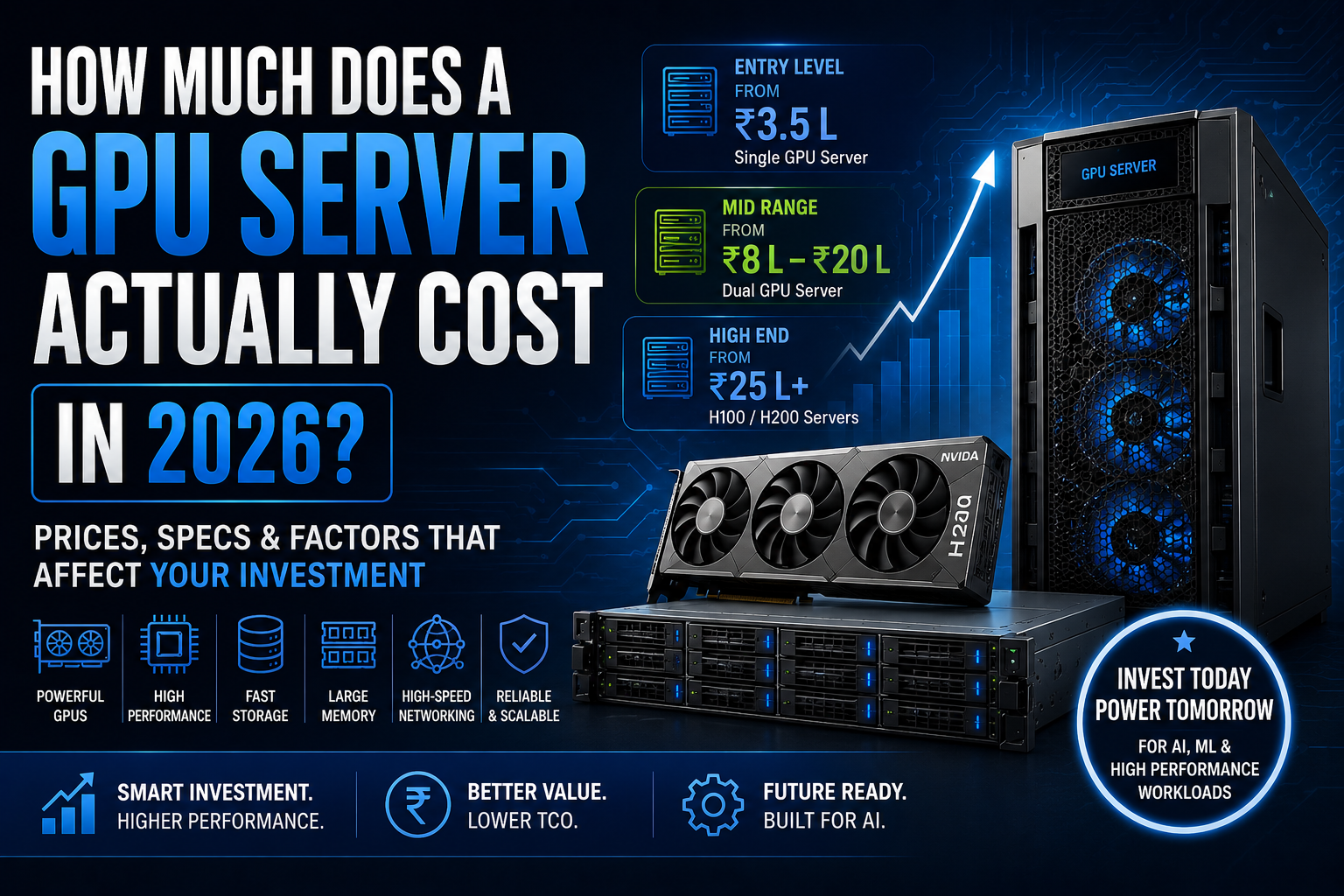
GPU server prices in 2026 vary widely depending on the GPU, memory, storage, networking, and cooling configuration. Learn what actually determines the cost before buying.
GPU servers have moved from specialized hardware used mainly by research organizations to an important part of modern business infrastructure. Companies are using them for machine learning, generative AI, computer vision, large language models, data analytics, rendering, and high-performance computing.
But there is one question almost every business asks before planning an AI infrastructure investment:
How much does a GPU server actually cost in 2026?
There isn't a single answer.
A GPU server can range from a relatively affordable system designed for development and inference to a highly specialized multi-GPU platform costing several lakhs or even much more. The biggest factor is usually the GPU itself, but CPU, RAM, storage, networking, power supplies, cooling, and server architecture can significantly change the final price.
Current Indian GPU-compute pricing illustrates the difference. IndiaAI's published price list includes single-GPU H100 and H200 instances alongside multi-GPU configurations, while commercial Indian providers currently publish dedicated H100 and H200 rental rates in the ₹1.8 lakh–₹2.5 lakh-per-month range.
So rather than focusing on one number, it's better to understand what you're actually paying for.
What Determines the Price of a GPU Server?
The GPU is usually the largest cost component, but it isn't the only one.
A complete GPU server may include:
- GPU accelerator
- Server chassis
- CPU
- System RAM
- NVMe or enterprise SSD storage
- RAID or storage controller
- Network adapters
- Power supplies
- Cooling system
- GPU interconnects
- Remote management
- Operating system or AI software
- Warranty and support
Two servers using the same GPU can therefore have very different prices.
For example, a single-GPU development server and an eight-GPU AI training system may use the same GPU family but have completely different CPU, memory, networking, power, and cooling requirements.
Entry-Level GPU Servers
Not every machine learning project needs an H100 or H200.
For development, computer vision, AI inference, rendering, and smaller machine learning workloads, businesses can consider professional GPUs with lower power requirements and smaller memory capacities.
Current Indian GPU-compute pricing provides useful context. IndiaAI lists L40S configurations at ₹135/hour for a two-GPU instance on its published price list, while commercial providers currently list L40S-based GPU nodes at considerably different monthly rates depending on configuration and service.
This category can be appropriate for:
- AI development
- Model testing
- Computer vision
- Video analytics
- Inference
- 3D rendering
- Engineering applications
For businesses starting their AI journey, buying a smaller GPU server can sometimes make more sense than immediately investing in a high-density AI system.
Mid-Range GPU Server Costs
The next category includes systems using GPUs such as the NVIDIA A100, L40S, and comparable professional accelerators.
These systems can be suitable for more demanding AI development, inference, fine-tuning, analytics, and research workloads.
For example, IndiaAI's published rates include A100 80GB configurations from ₹179/hour for a two-GPU instance, with lower hourly rates for longer reserved commitments.
The actual purchase price of a physical server will depend on whether you're buying:
- One GPU
- Two GPUs
- Four GPUs
- Eight GPUs
- PCIe GPUs
- SXM GPUs
- A complete OEM-certified platform
This is why simply searching for an "A100 server price" can produce very different numbers.
NVIDIA H100 Server Cost
The NVIDIA H100 remains one of the most widely recognized accelerators for enterprise AI and high-performance computing.
However, an H100 server is not simply an H100 GPU installed inside an ordinary server chassis.
A high-end H100 system may require:
- Powerful CPUs
- Large amounts of system RAM
- High-speed NVMe storage
- High-speed networking
- Large power supplies
- Advanced cooling
- Multi-GPU interconnects
Current IndiaAI pricing lists a single H100 SXM instance at ₹153/hour on-demand, while its published eight-GPU H100 SXM price is ₹1,224/hour. Longer reserved commitments are priced lower.
A commercial Indian provider currently lists a dedicated H100 node at ₹1,80,000 per month in Mumbai, illustrating how rental economics can differ from purchasing physical infrastructure.
The key point is that GPU rental pricing should not be treated as the purchase price of a physical server. Rental rates include infrastructure, power, data-center facilities, and service economics.
NVIDIA H200 Server Cost
The H200 sits at the higher end of the AI accelerator market.
Its major advantage over H100 is its larger and faster GPU memory system. NVIDIA specifies 141GB of HBM3e memory and 4.8TB/s memory bandwidth for H200.
That makes H200 particularly attractive for:
- Large language models
- Generative AI
- Large-model inference
- Fine-tuning
- HPC
- Memory-intensive workloads
Current Indian pricing provides a useful indication of operating cost. IndiaAI lists a single H200 SXM instance at ₹140/hour on demand and eight-GPU H200 SXM at ₹1,125/hour.
Meanwhile, a commercial Mumbai provider currently lists a dedicated H200 node at ₹2,50,000 per month, with managed operations priced separately.
Again, these figures are rental benchmarks rather than fixed hardware purchase prices.
Why an Eight-GPU Server Costs So Much More
It might seem logical that an eight-GPU server should cost roughly eight times a single-GPU server.
In reality, the difference can be larger.
High-density AI servers often require additional infrastructure for:
Power:
Multiple high-performance GPUs can consume several kilowatts under load.
Cooling:
High-density GPU systems generate substantial heat and may require specialized air or liquid cooling.
Networking:
Distributed AI workloads may require high-speed Ethernet, InfiniBand, RDMA, or other networking technologies.
GPU interconnect:
Large AI systems may use NVLink and NVSwitch to improve GPU-to-GPU communication.
CPU and RAM:
Multiple GPUs require a capable host platform to keep accelerators supplied with data.
This is why an enterprise AI server should be viewed as a complete computing platform rather than a collection of graphics cards.
How Much Should You Budget for a GPU Server?
Instead of setting a budget based on a GPU name, divide your requirements into three broad categories.
Development and Smaller AI Workloads
A lower-density GPU server can be suitable for:
- AI development
- Testing
- Computer vision
- Inference
- Rendering
These systems can provide a practical starting point without the infrastructure requirements of a multi-GPU AI cluster.
Enterprise AI
Businesses running larger models, production inference, or demanding analytics should consider professional multi-GPU configurations.
At this level, the GPU, RAM, storage, networking, and cooling requirements increase considerably.
Large-Scale AI Training
Large model training can require four, eight, or many more GPUs distributed across multiple servers.
At this level, infrastructure cost isn't limited to the servers. Networking, storage, power, cooling, data-center space, and software can become major parts of the investment.
Buying vs Renting a GPU Server
One of the biggest decisions in 2026 is whether to buy a GPU server or rent GPU compute.
Buying makes sense when:
- GPU utilization is consistently high.
- You expect to use the system for several years.
- Data must remain within your infrastructure.
- You need predictable hardware availability.
- Long-term utilization justifies capital expenditure.
Renting can make sense when:
- AI workloads are temporary.
- You need GPUs only occasionally.
- You're testing a new model.
- You want to avoid large upfront investment.
- You need access to expensive GPUs without maintaining the hardware.
Current Indian GPU rental markets demonstrate how dramatically costs can vary by GPU and configuration. Maapan's July 2026 price aggregation shows median commercial rates of approximately ₹329/GPU-hour for H100 and ₹370.60/GPU-hour for H200 across the sources it tracks.
This makes utilization one of the most important factors in deciding whether buying or renting is financially sensible.
Don't Forget Total Cost of Ownership
The purchase price is only the beginning.
A GPU server also consumes electricity and requires cooling, maintenance, networking, storage, and potentially replacement components.
Your total cost of ownership can include:
- Hardware purchase
- Electricity
- Cooling
- Data-center space
- Network infrastructure
- Storage
- Software
- Maintenance
- Warranty
- Hardware upgrades
For a high-utilization server, electricity and cooling can become significant operational expenses over several years.
New vs Refurbished GPU Servers
Businesses with a limited budget can also consider refurbished enterprise server platforms.
A refurbished server may be useful for:
- AI development
- Testing
- Inference
- Research
- Computer vision
- Rendering
- Secondary workloads
However, GPU compatibility needs to be checked carefully.
Before installing a GPU into refurbished hardware, verify:
- Supported GPU models
- Power supply capacity
- PCIe configuration
- Cooling capability
- Physical clearance
- Firmware compatibility
- Driver support
High-end GPUs should not simply be installed into an old server without confirming that the complete platform can support them.
What Is the Best GPU Server for Your Budget?
There is no universal "best" GPU server.
If you're building an AI development system, a single professional GPU may be enough.
If you're running production inference, you may benefit from multiple GPUs and larger memory capacity.
If you're training large language models, high-end accelerators such as H100 or H200 can become appropriate.
The correct decision depends on:
Model size + GPU memory + workload + utilization + performance target + budget
Start with your workload and work backward toward the hardware.
Final Verdict
So, how much does a GPU server actually cost in 2026?
The answer can range from a relatively modest professional GPU system to a highly specialized multi-GPU AI platform costing many times more.
Current Indian GPU-compute prices show just how broad the range is: commercial H100 and H200 GPU nodes can cost roughly ₹1.8 lakh to ₹2.5 lakh per month to rent from individual providers, while IndiaAI's published compute rates show significant differences between single-GPU and multi-GPU configurations.
But rental pricing isn't the same as hardware purchase pricing.
For businesses considering a physical GPU server, the better question is:
"What GPU server configuration gives me the performance I need at the lowest practical total cost?"
A well-balanced server with the right GPU, RAM, storage, CPU, networking, power, and cooling can deliver much better value than simply buying the most powerful GPU available.
In 2026, the smartest GPU server investment is therefore not necessarily the most expensive one.
It's the one that matches your workload today while leaving enough room for tomorrow's AI requirements.
Frequently Asked Questions
How much does a GPU server cost in 2026?
GPU server costs vary significantly depending on the GPU, number of accelerators, CPU, RAM, storage, networking, power, and cooling. High-end H100 and H200 systems can cost substantially more than single-GPU development servers.
How much does an H100 GPU server cost in India?
Rental pricing varies by provider and configuration. One Mumbai provider currently lists a dedicated H100 node at ₹1,80,000 per month, while IndiaAI's published compute pricing lists H100 instances at different hourly rates depending on configuration and reservation period.
How much does an H200 server cost in India?
Current published rental pricing varies. One Mumbai provider lists a dedicated H200 node at ₹2,50,000 per month, while IndiaAI lists H200 instances at different hourly rates depending on GPU configuration and reservation duration.
Is it cheaper to buy or rent a GPU server?
It depends on utilization. Buying can be more economical when GPUs are heavily used for several years, while renting can be attractive for temporary, experimental, or unpredictable workloads.
What makes a GPU server expensive?
The GPU is usually the largest cost component, but high-end CPUs, large amounts of RAM, NVMe storage, networking, power supplies, cooling, and multi-GPU interconnects can significantly increase the total system cost.
Is an H200 worth the extra cost over an H100?
It depends on your workload. H200 is particularly valuable when applications benefit from its larger GPU memory and higher memory bandwidth. If your workload fits comfortably within H100 memory, the additional cost may not provide enough benefit.
Can I build a GPU server using refurbished hardware?
Yes, depending on the GPU and server platform. However, power, cooling, PCIe compatibility, physical space, firmware, and GPU support must be verified before purchasing.
How much RAM does a GPU server need?
It depends on the workload. AI training and large-model workloads can require hundreds of gigabytes or more of system RAM, while smaller inference and development workloads may need considerably less.
Do GPU servers need special cooling?
High-performance GPU servers can generate substantial heat. Multi-GPU systems may require advanced airflow or liquid-cooling solutions depending on the GPU and server design.
What should I check before buying a GPU server?
Check GPU memory, GPU performance, CPU, system RAM, storage, PCIe topology, GPU interconnects, networking, power supplies, cooling, server compatibility, warranty, and future upgrade options.