AMD vs Intel Servers in 2026: What Actually Matters for Your Workload
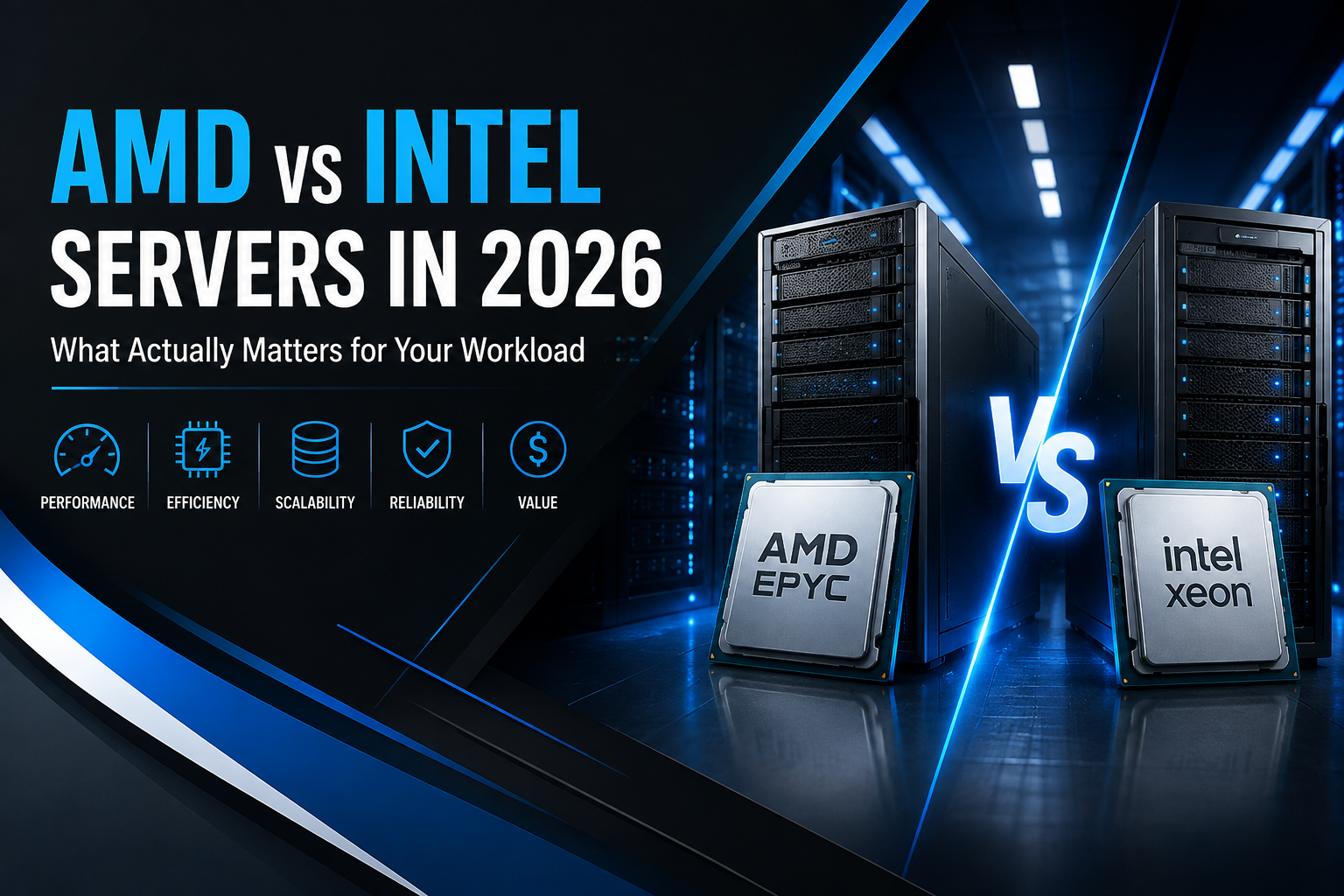
AMD or Intel — which server CPU actually fits your workload in 2026? We break down EPYC vs Xeon for virtualization, databases, storage, and AI so you can stop guessing and start matching hardware to what your server actually runs.
Stop Picking a Server CPU Like You're Picking a Team Jersey
Every year, the AMD vs Intel servers debate gets framed like a rivalry you're supposed to have a side in. It isn't. Whether you're comparing AMD servers or Intel servers for your next dedicated box, the honest answer is this: the "best" server CPU depends entirely on what you're running on it. A processor that's brilliant for a virtualization-heavy hosting node might be the wrong pick for a database that lives and dies on single-thread speed.
This guide breaks down what's actually different between AMD EPYC and Intel Xeon servers in 2026, and — more importantly — how to match that difference to your workload instead of a marketing slide.
The Current Lineup, In Plain English
AMD EPYC (9005 series, codename "Turin") continues AMD's multi-generation streak of leading on raw core count, memory bandwidth, and I/O. Current-generation EPYC chips scale up toward 192 cores per socket, run 12-channel DDR5 memory, and offer 128 lanes of PCIe 5.0 per socket — which matters a lot if you're feeding multiple accelerators or NVMe drives.
Intel Xeon 6 (built on "Granite Rapids" and "Sierra Forest") has closed a lot of the gap that opened up during the mid-2020s. Xeon 6 now reaches up to 128 cores per socket, still edges ahead on single-threaded performance, and brings AMX (Advanced Matrix Extensions) into the mix — a meaningful advantage for AI inference workloads that don't need a dedicated GPU.
Neither company is "behind" anymore. That's actually the most useful thing to understand walking into a purchase decision: the gap that used to make this an easy call has narrowed, so the workload — not the brand — should decide.
AMD EPYC vs Intel Xeon: The Workload Breakdown
Virtualization and Cloud Hosting
If you're running a hosting platform, VDI environment, or anything where you're stacking dozens (or hundreds) of virtual machines onto one physical box, core count and memory bandwidth win. This is where AMD EPYC servers tend to pull ahead — more cores per socket means higher VM density per server, which usually translates into a lower cost per VM over the life of the hardware.
Intel Xeon still holds up well here, particularly in mixed environments where licensing costs (Oracle, SQL Server) are calculated per-core — Xeon's higher per-core clock speed can mean fewer total cores needed to hit the same performance target, which sometimes offsets EPYC's density advantage.
Databases and Transactional Workloads (OLTP)
Single-threaded and lightly-threaded performance still matters more than raw core count for classic transactional databases. This is Intel Xeon's home turf — if your workload is dominated by single-query speed rather than parallel throughput, Xeon Gold-class chips typically outperform EPYC by a noticeable margin on a per-core basis.
AI and Machine Learning
This is workload-dependent in a way that surprises a lot of buyers:
- Training large models at scale is usually GPU-bound anyway, but the CPU still matters for data preprocessing and keeping GPUs fed — AMD EPYC's memory bandwidth advantage reduces GPU idle time in multi-accelerator training rigs.
- Inference, especially CPU-only inference, is where Intel's AMX acceleration earns its keep. For businesses running smaller models or classical ML pipelines without dedicated GPUs, Xeon can be the more cost-effective route.
Storage-Heavy and I/O-Intensive Applications
More PCIe lanes means more room for NVMe drives, network cards, and storage controllers without contention. AMD EPYC's higher PCIe lane count per socket generally gives it the edge for storage servers, SAN back-ends, and object storage clusters.
Cost: The Gap Has Closed More Than People Realize
For years, "AMD is cheaper" was a safe assumption in any AMD servers vs Intel servers conversation. That's no longer a guarantee. Pricing has converged across most tiers — AMD still tends to hold a per-watt efficiency edge at the high end, but Intel has become considerably more competitive in the mid-range. If your buying decision hinges purely on sticker price, it's worth getting current quotes on both rather than assuming which one wins.
Power efficiency is where the real cost savings usually show up over a server's lifetime — not in the upfront hardware price, but in the electricity and cooling bill that follows it for the next 3–5 years.
Don't Forget the Ecosystem Question
Beyond raw specs, there's a practical layer that matters for real deployments: software certification, hypervisor support, and vendor familiarity. Both AMD EPYC and Intel Xeon are fully supported across major virtualization platforms today, so this is less of a differentiator than it was a few years ago — but if you're running older, niche, or highly specialized enterprise software, it's worth confirming certification on your specific CPU generation before committing to a purchase or lease.
So, Which Server Should You Actually Buy?
If you take one thing away from this: stop asking "which server CPU is better" and start asking "what is my server actually going to do all day." A dedicated server built for high-density hosting has a different ideal CPU than one built for a single mission-critical database, and both are different again from a server built to feed a GPU cluster.
At Servers2.com, we build and configure both AMD EPYC and Intel Xeon servers around the workload you're actually running — not around whichever brand happens to be trending. If you're not sure which platform fits your setup, that's exactly the kind of question worth asking before you buy, not after.
FAQ: AMD vs Intel Servers in 2026
Is AMD EPYC better than Intel Xeon for servers in 2026? It depends on the workload. AMD EPYC generally leads in core count, memory bandwidth, and PCIe lanes, making it strong for virtualization and storage-heavy servers. Intel Xeon leads in single-thread performance and AI inference acceleration, making it strong for databases and CPU-only inference workloads.
Are AMD servers cheaper than Intel servers? Not automatically anymore. Pricing has converged significantly across most tiers in 2026. AMD tends to hold a per-watt efficiency edge at the high end, but Intel has become more price-competitive in the mid-range.
Which server CPU is better for virtualization? AMD EPYC generally offers higher VM density thanks to higher core counts and memory bandwidth, which often lowers the cost per virtual machine at scale.
Which server CPU is better for AI workloads? It splits by task: AMD EPYC's memory bandwidth benefits GPU-fed training pipelines, while Intel Xeon's AMX acceleration benefits CPU-only inference workloads.
Do I need to choose one platform for my entire infrastructure? No. Many businesses run a mixed environment — Intel Xeon for latency-sensitive databases, AMD EPYC for virtualization or storage nodes — matched to each workload rather than standardized on a single CPU brand.