AI Inference Servers vs AI Training Servers: What's the Difference?
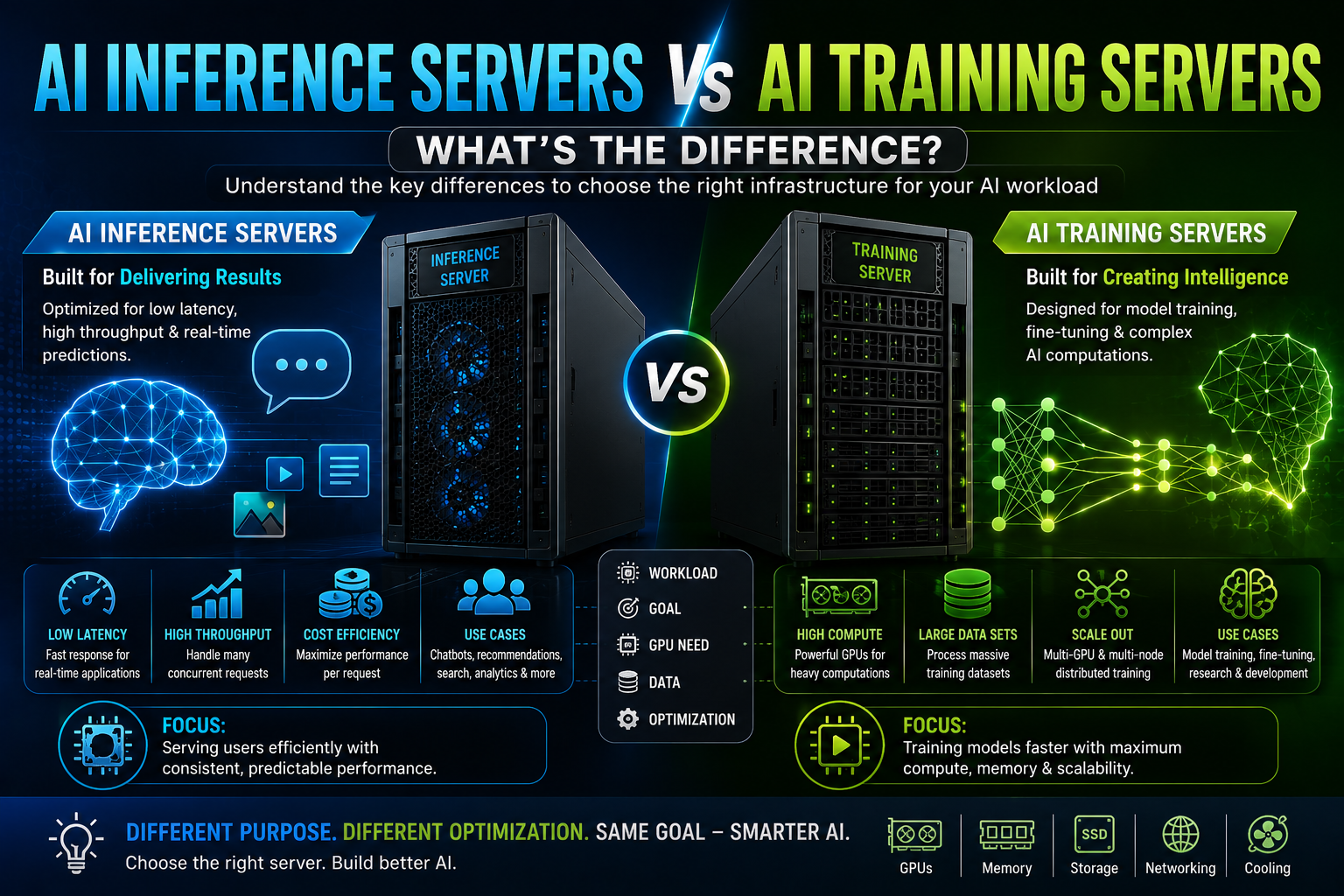
AI training and inference use the same fundamental technologies but require different server configurations. Learn how GPUs, memory, storage, networking, and scalability differ between them.
Artificial intelligence workloads are no longer limited to research laboratories. Businesses are now using AI for customer support, recommendation systems, document processing, computer vision, analytics, automation, and generative AI applications.
But not every AI workload needs the same type of server.
An AI training server is designed to teach a model by processing large datasets and continuously updating model parameters. An AI inference server takes an already-trained model and uses it to generate predictions or responses.
Although both environments rely heavily on GPUs, their infrastructure priorities can be very different.
Understanding this difference is important when you're planning an AI server because buying an expensive training-focused system for a relatively simple inference workload can lead to unnecessary infrastructure costs.
What Is an AI Training Server?
An AI training server is designed to build or improve machine learning models.
During training, a model processes large quantities of data repeatedly. The server calculates errors, adjusts model parameters, and continues this process until the model reaches the desired level of accuracy.
Training workloads can include:
- Large language model training
- Deep learning
- Computer vision training
- Recommendation model training
- Natural language processing
- Generative AI
- Scientific machine learning
- Model fine-tuning
These workloads can run for hours, days, or even weeks depending on the model and infrastructure.
NVIDIA's current guidance for deep-learning training emphasizes high-performance CPUs, large system memory, multiple GPUs, fast NVMe storage, balanced PCIe topology, and high-speed networking.
What Is an AI Inference Server?
An AI inference server is used after a model has been trained.
Instead of teaching the model, the server uses the trained model to process new inputs and produce outputs.
For example:
A customer sends a question to an AI chatbot → the inference server processes the request → the trained model generates an answer.
Inference can be used for:
- AI chatbots
- Search
- Recommendation engines
- Fraud detection
- Computer vision
- Speech recognition
- Document analysis
- Generative AI
- Real-time automation
- AI-powered applications
Inference workloads can run in a data center, cloud environment, or at the edge.
The infrastructure priority is often low latency, high throughput, predictable response times, and efficient cost per request rather than maximum training throughput.
AI Training vs AI Inference: The Core Difference
The easiest way to understand the difference is:
Training = creating or improving the model
Inference = using the trained model
Training generally requires much more compute-intensive processing and large datasets.
Inference may require less overall compute per request, but production systems can receive thousands or millions of requests, making efficiency and latency extremely important.
This means an inference server can be optimized around serving users efficiently rather than simply maximizing raw GPU performance.
GPU Requirements Are Different
The GPU is one of the most important components in both types of servers, but the ideal configuration can differ.
Training Servers
Training systems generally prioritize:
- High-end GPUs
- Large GPU memory
- High memory bandwidth
- Multiple GPUs
- High-speed GPU-to-GPU communication
- NVLink or similar interconnects
- High-speed networking
Large training environments may use four, eight, or many more GPUs across multiple servers.
NVIDIA's current certified-system guidance recommends 2, 4, or 8 GPU configurations for deep-learning training systems, with GPUs balanced across CPU sockets and PCIe root ports.
Inference Servers
Inference servers can use fewer GPUs depending on the model and expected traffic.
The priorities may include:
- GPU memory
- Inference throughput
- Response latency
- Power efficiency
- Cost per inference
- Number of simultaneous requests
For example, an enterprise inference system may use two or four GPUs rather than deploying a large training cluster.
However, large language models can require substantial GPU resources even during inference.
GPU Memory Matters for Both
GPU memory is critical for both training and inference.
A model must fit within available memory, either on a single GPU or across multiple GPUs.
For large language models, memory requirements can become particularly significant.
NVIDIA's H200, for example, provides 141GB of HBM3e memory and 4.8TB/s of memory bandwidth, making it suitable for demanding generative AI and HPC workloads.
Training typically needs memory for:
- Model parameters
- Gradients
- Activations
- Optimizer states
- Training batches
Inference typically needs memory for:
- Model parameters
- Runtime data
- KV cache
- Input and output processing
- Concurrent requests
The memory requirements depend heavily on the model architecture and implementation.
CPU Requirements
The CPU still matters even in a GPU-focused AI server.
For training, CPUs can handle:
- Data preprocessing
- Dataset loading
- Data augmentation
- Storage operations
- Networking
- Job management
For inference, CPUs can handle:
- Request processing
- API operations
- Data preparation
- Application logic
- Networking
- Model orchestration
NVIDIA's current certified-system recommendations call for PCIe Gen5-capable CPUs and at least six physical CPU cores per GPU for both inference and deep-learning training configurations.
The exact requirement depends on the workload, but the important point is that GPUs should not be treated as the only performance component.
System RAM Requirements
Training servers typically need substantial system RAM because training datasets can be very large and data preprocessing can consume significant memory.
Inference servers may require less system memory for smaller deployments.
However, large-scale inference can still require substantial CPU memory, especially when serving large models or managing large caches and multiple concurrent workloads.
NVIDIA's current reference recommendations specify system memory of at least 2× total GPU memory for both its inference and deep-learning training system configurations.
This is a useful reference point, but actual requirements should be calculated from the application.
Storage Requirements
Storage is another area where training and inference can differ considerably.
Training Storage
Training servers often need high-performance storage because they repeatedly access large datasets.
Fast NVMe storage can help keep GPUs supplied with data and reduce data-loading bottlenecks.
Training environments may store:
- Large datasets
- Model checkpoints
- Training outputs
- Logs
- Intermediate files
NVIDIA's training guidance recommends high-bandwidth NVMe storage.
Inference Storage
Inference servers generally don't need to store massive training datasets locally.
Instead, they may primarily need storage for:
- Model files
- Containers
- Operating systems
- Logs
- Temporary data
- Application files
For large-model deployments, fast local NVMe storage can still be useful for model loading and caching.
Networking Requirements
Networking becomes especially important for distributed AI training.
A training cluster may need to move huge amounts of data between GPUs and servers.
High-speed Ethernet or InfiniBand can therefore become an important part of the infrastructure.
Inference networking has a different focus.
The server needs to handle:
- User requests
- API traffic
- Model-serving traffic
- Storage access
- Monitoring
- Inter-service communication
For large multi-node inference systems, networking can also become a major performance factor.
NVIDIA's current certified-system guidance recommends at least 200Gbps networking for multi-node inference and emphasizes balanced PCIe topology.
Latency vs Throughput
This is one of the most important differences.
Training focuses heavily on throughput.
The goal is to process as much training data as efficiently as possible.
Reducing training time can significantly reduce infrastructure costs.
Inference often focuses on latency and throughput together.
Users expect an AI application to respond quickly.
For example, a chatbot that takes 30 seconds to respond to every question may provide a poor user experience even if the server can process many requests simultaneously.
Modern inference architectures can even separate the prefill and decode phases because they place different demands on infrastructure. NVIDIA describes prefill as more compute-intensive and decode as more memory-bandwidth-sensitive.
Cooling and Power Requirements
High-performance AI GPUs can consume substantial power.
Training servers may run GPUs continuously at high utilization for extended periods, making power and cooling particularly important.
Inference servers can also run continuously, but their power profile depends on utilization and workload.
A production AI server should therefore be evaluated for:
- GPU power
- CPU power
- PSU capacity
- Airflow
- Rack density
- Ambient temperature
- Cooling technology
- Expected utilization
High-density GPU deployments may require advanced cooling designs.
Do Training and Inference Need Different GPUs?
Not necessarily.
The same GPU family can often be used for both training and inference.
For example, NVIDIA H100 and H200 accelerators can support both types of workloads.
The difference is usually how the system is configured and optimized.
A training server may prioritize eight GPUs, high-speed GPU interconnects, large storage and high-bandwidth networking.
An inference server might use fewer GPUs while emphasizing latency, utilization, model serving, and cost efficiency.
Can One Server Handle Both Training and Inference?
Yes.
A GPU server can potentially run both training and inference workloads.
However, combining them requires careful resource management.
A long-running training job can consume most of the available GPU resources and negatively affect inference latency.
For production environments, separating training and inference infrastructure can therefore provide better predictability.
Some organizations use:
Training cluster → Build and fine-tune models.
Inference cluster → Serve production applications.
This separation also allows each environment to be optimized for its own requirements.
Which Server Is More Expensive?
Generally, training infrastructure can become more expensive, especially for large-scale model training.
Training systems may require:
- More GPUs
- Larger GPU memory
- High-speed interconnects
- More system RAM
- High-performance storage
- High-speed networking
- Larger power infrastructure
- Advanced cooling
Inference infrastructure can often be smaller, although large-scale production inference can also become extremely expensive.
The cost depends on model size, user demand, performance targets, and deployment scale.
When Should You Choose an AI Training Server?
A training-focused server makes sense when your organization needs to:
- Train machine learning models
- Fine-tune large models
- Process large datasets
- Perform deep-learning research
- Run computer-vision training
- Develop generative AI models
- Perform HPC workloads
If training time is a major business concern, investing in stronger GPU infrastructure can provide significant value.
When Should You Choose an AI Inference Server?
An inference server is appropriate when the model already exists and needs to be deployed for users or applications.
Common examples include:
- AI chatbot deployment
- RAG applications
- Computer vision inference
- Recommendation systems
- AI search
- Document processing
- Speech applications
- Real-time analytics
For these workloads, focus heavily on latency, throughput, GPU utilization, memory, and cost per request.
AI Training vs Inference Server: Which One Should You Buy?
Start with one question:
What does your AI workload actually need to do?
If you're creating or improving models, prioritize training infrastructure.
If you're deploying an existing model to users, prioritize inference infrastructure.
If you're doing both, consider separate systems or a carefully designed infrastructure that can allocate resources between workloads.
Final Verdict
AI training servers and AI inference servers may use similar hardware, but they are optimized for different jobs.
Training servers are designed around high compute throughput, large datasets, multi-GPU scaling, fast storage, and high-speed GPU and network communication.
Inference servers are designed around efficient model serving, low latency, predictable throughput, GPU memory, and cost-effective deployment.
NVIDIA's current guidance reflects this distinction, with training systems emphasizing high-performance CPUs, multiple GPUs, large memory, high-speed storage, and balanced multi-GPU topology, while inference configurations can be optimized around the required model size, latency, GPU count, and deployment environment.
For businesses planning AI infrastructure in 2026, the smartest approach is to design the server around the workload rather than simply choosing the most powerful GPU available.
A high-end training server may be unnecessary for a simple inference application, while an undersized inference system can struggle when user demand increases.
Understand the workload first. Then choose the GPU, server, storage, networking, cooling, and software stack around it.
Frequently Asked Questions
What is the difference between AI training and AI inference?
AI training creates or improves a model by processing datasets and updating model parameters. AI inference uses an already-trained model to generate predictions, classifications, or responses.
Is a training server more powerful than an inference server?
Not necessarily. Training servers are generally optimized for large-scale compute and multi-GPU workloads, while inference servers are optimized around latency, throughput, efficiency, and production serving requirements.
Can an H100 server be used for both training and inference?
Yes. H100 is designed to support both AI training and inference workloads. The optimal server configuration depends on how the GPU will be used.
Is H200 good for AI inference?
Yes. H200's 141GB HBM3e memory and 4.8TB/s memory bandwidth make it particularly attractive for large-model inference and other memory-intensive AI workloads.
How many GPUs does an AI training server need?
It depends on the model and training requirements. Smaller workloads may use one or two GPUs, while large-scale training can require four, eight, or many more GPUs across multiple servers.
Do AI inference servers need multiple GPUs?
Not always. Smaller models may run effectively on one GPU, while larger models or high-traffic production environments may require multiple GPUs.
Does AI training require more storage than inference?
Usually, yes. Training environments often process and store large datasets, checkpoints, and intermediate results. Inference servers generally need storage primarily for models, applications, logs, and caching.
Which needs faster networking, training or inference?
Large distributed training workloads often have extremely demanding networking requirements because GPUs and servers exchange large amounts of data. Large-scale inference can also require high-speed networking, particularly in multi-node deployments.
Can training and inference run on the same server?
Yes, but resource management is important. For production environments, separating training and inference can provide more predictable performance.
What should I consider when buying an AI server?
Consider GPU memory, GPU count, CPU, system RAM, PCIe topology, GPU interconnect, NVMe storage, networking, power, cooling, software compatibility, workload size, and future scalability.